


Free template

Study guide template and example

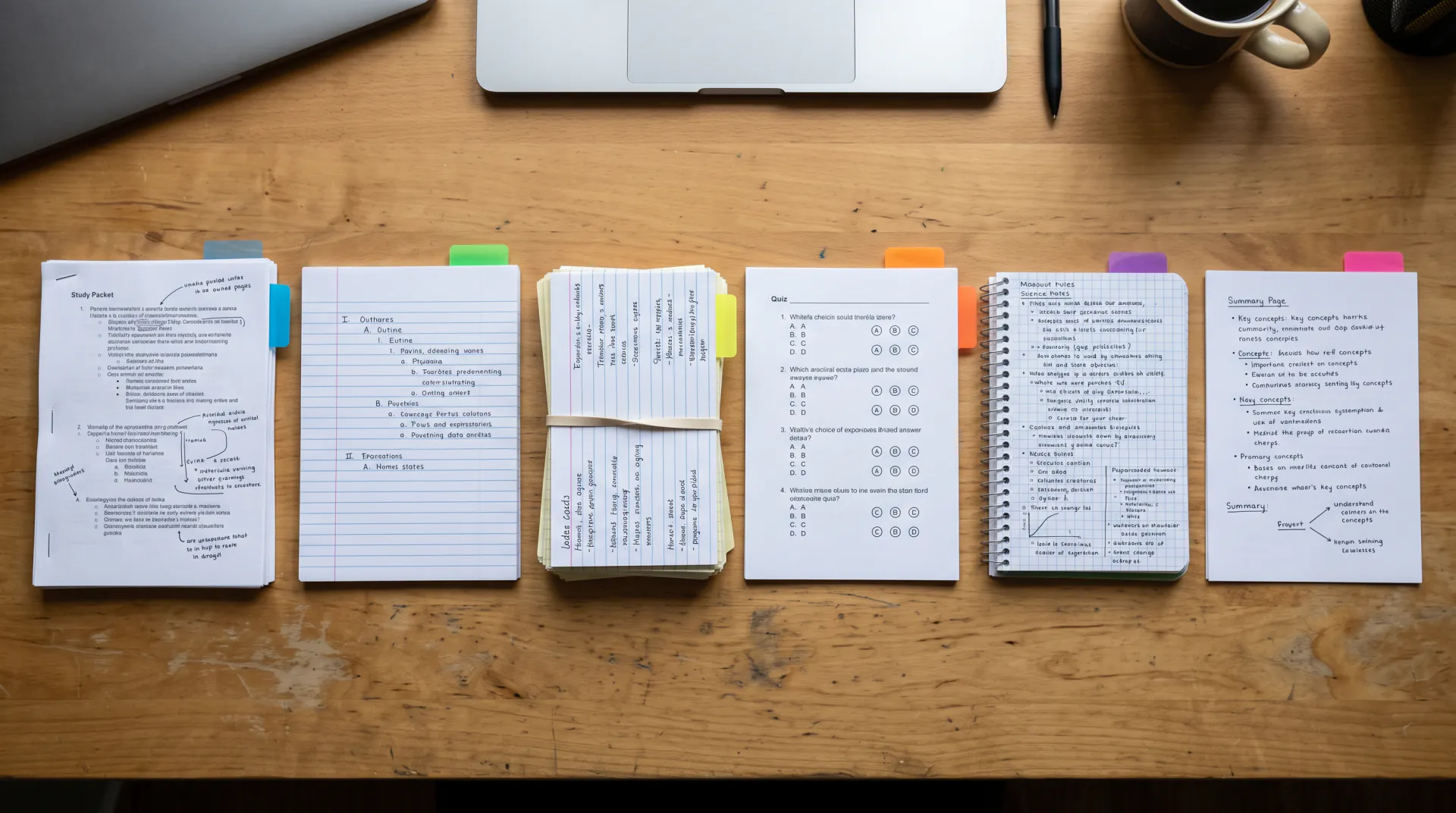
Copy this study guide template for free and fill it in by hand, or paste your notes into the maker and get the same sections written from your material.

  • Free to copy
  • Filled-in example
  • Sample notes to try
Format
Depth
0 / 4,000 words

Study aid

Paste your notes and press Create. Your study guide, quiz or flashcards appear here.

At a glance

A good study guide template has seven parts: the topic and exam date, an overview, key concepts, key terms, important details to memorize, review questions and their answers. Copy the template below and fill it in by hand, read the filled-in example for a supply and demand unit, or paste your own notes into AI Study Guide Maker, which writes the same sections using purchased credits.

Template sections
7, from the topic to the answers
Free to use
The template, the example and the sample notes on this page
AI fill-in
1 purchased credit per word of notes, 300-credit minimum
Notes length
50 to 4,000 words of pasted text per request

What each part of the template is for

  • 01

    Overview

    Two to four sentences that say what the topic is and why it matters, so you start with the big picture.

  • 02

    Key concepts and terms

    The ideas you must be able to explain, and the words you must be able to define.

  • 03

    Important details

    Dates, formulas, people and steps you need to memorize, kept in one place.

  • 04

    Review questions and answers

    Questions that test understanding, with the answers on a separate list you can cover.

How to use the study guide template

  1. 01

    Copy it

    Copy the template into a document or onto paper.

  2. 02

    Fill it from your notes

    Work through one topic section by section, and skip a section that does not apply.

  3. 03

    Test yourself

    Cover the answers, answer the questions, then review what you missed.

Study guide template to copy and fill in

Copy the seven lines below. The words in brackets say what to write in each part.

  • Topic and exam date: [the course, unit or chapter, and when you are tested]
  • Overview: [two to four sentences on what the topic covers]
  • Key concepts: [a numbered list; each concept, a colon and a short explanation]
  • Key terms: [each term, a colon and its definition in your own words]
  • Important details: [dates, formulas, people, steps or figures to memorize]
  • Review questions: [five to ten questions that test understanding]
  • Answers: [numbered to match the questions, on a separate list]

Example: a filled-in study guide for supply and demand

This example was written by hand from the sample economics notes in the tool above, to show the template filled in. A study guide the maker writes from the same notes uses the same sections in its own words, with the topic as its title line; the exam date is yours to add.

  • Topic: Econ 101, unit 2, supply and demand
  • Overview: Markets settle on the price where buyers' and sellers' plans meet. A change in price moves along the supply and demand curves; other changes shift them.
  • Key concept, law of demand: when price rises, quantity demanded falls, other things equal
  • Key concept, law of supply: when price rises, quantity supplied rises
  • Key term, equilibrium: the price at which quantity supplied equals quantity demanded
  • Important detail: a price ceiling set below equilibrium causes a shortage
  • Review question: What happens to the demand curve when buyers' incomes change?
  • Answer: The whole demand curve shifts; a change in the good's own price only moves along it

Tips for filling in the template

The template works best when you:

  • Write definitions in your own words, not copied ones
  • Keep the answers on a separate list or the back of the page
  • Make one guide per unit, not one for the whole course
  • Start several days before the exam, not the night before

Sample notes to try

Short class notes written for this page. Copy one, or press Try it to open it in the maker and choose a format.

Science

  • Cell structure

    Biology notes: cell structure. The cell membrane controls what enters and leaves the cell. The nucleus holds the DNA and directs the cell's activities. Mitochondria release energy from glucose through cellular respiration, making ATP. Ribosomes build proteins. Rough endoplasmic reticulum has ribosomes and helps make proteins; smooth ER makes lipids. The Golgi apparatus modifies, sorts and packages proteins. Plant cells also have a cell wall made of cellulose, chloroplasts and a large central vacuole. Prokaryotic cells, such as bacteria, have no nucleus.

    Try it
  • Newton's laws of motion

    Physics notes: Newton's laws. First law (inertia): an object stays at rest or keeps moving at a constant velocity unless a net force acts on it. Second law: F = ma, so the net force equals mass times acceleration; force is measured in newtons (1 N = 1 kg m/s^2). Third law: for every action there is an equal and opposite reaction, and the two forces act on different objects. Weight is mass times gravitational acceleration, W = mg, with g about 9.8 m/s^2 near Earth's surface. Friction acts against the direction of motion.

    Try it

History and government

  • The Industrial Revolution

    History notes: the Industrial Revolution. It began in Britain in the late 1700s. Key inventions: the spinning jenny (James Hargreaves, about 1764), James Watt's improved steam engine (patented 1769) and the power loom (Edmund Cartwright, 1785). Factories moved textile production out of homes. Why Britain: coal and iron deposits, colonies and trade, a growing population, capital to invest and the earlier agricultural revolution. Effects: rapid urbanization, child labor, poor working conditions, a growing middle class and the rise of labor unions.

    Try it
  • The Bill of Rights

    Government notes: the Bill of Rights is the first ten amendments to the US Constitution, ratified in 1791. First Amendment: freedom of religion, speech, the press, assembly and petition. Second: the right to keep and bear arms. Fourth: protection against unreasonable searches and seizures. Fifth: due process, no double jeopardy and the right not to testify against yourself. Sixth: a speedy and public trial by jury and the right to a lawyer. Eighth: no excessive bail and no cruel and unusual punishment. Tenth: powers not given to the federal government are reserved to the states or the people.

    Try it

English and writing

  • Literary devices

    English notes: literary devices. A metaphor compares two things without like or as (time is a thief); a simile uses like or as (brave as a lion). Personification gives human qualities to something that is not human. Alliteration repeats the first consonant sound in nearby words. Foreshadowing hints at what will happen later. Irony: verbal irony says the opposite of what is meant; dramatic irony is when the audience knows something a character does not; situational irony is when the outcome is the opposite of what was expected. Imagery is language that appeals to the senses.

    Try it
  • Rhetorical appeals

    Writing notes: rhetorical appeals. Aristotle described three modes of persuasion. Ethos appeals to the speaker's credibility and character. Pathos appeals to the audience's emotions. Logos appeals to logic and evidence, such as facts, statistics and reasoning. Kairos, often added as a fourth idea, is about timing: saying the right thing at the right moment. Strong arguments usually combine the appeals. Common fallacies: ad hominem attacks the person instead of the argument; a straw man misrepresents the other side's argument; a false dilemma offers only two options when more exist.

    Try it

Study guide template FAQ

Is this study guide template free?

Yes. The template, the filled-in example and the sample notes on this page are free to copy and use, without an account. Only the AI maker, which writes the sections from your notes, uses purchased credits.

What should a study guide include?

An overview, the key concepts, key terms with definitions, the details you must memorize, and review questions with answers. Put the topic and exam date at the top so you know what it covers.

Can I use the template in Google Docs or Word?

Yes. Copy the template text and paste it into any document editor. The AI maker's output is plain text too, so it pastes the same way, ready for your own formatting.

How is the AI study guide different from the template?

The sections are the same, except that the maker cannot know your exam date, so add it yourself. The maker writes the sections from your notes in one step and lists anything your notes mention without explaining. Filling the template in by hand takes longer, but is itself a good way to learn.

Fill in the template from your notes

Paste your notes and the maker writes every section. Packs start at $4.99.

Last updated October 29, 2026

Create your AI Study Guide Maker account